
Section 8 Companies vs. Trusts vs. Societies: Why High-Impact NGOs are Moving to a Corporate Structure
In 2026, social entrepreneurship in India is evolving. While the traditional "Trust" or "Society" remains common, founders seeking long-term credibility, foreign funding (FCRA), and CSR partnerships are increasingly choosing the Section 8 Company. Why?
MINISTRY OF CORPORATE AFFAIRS
CA Prachi Gupta
4/21/20261 min read
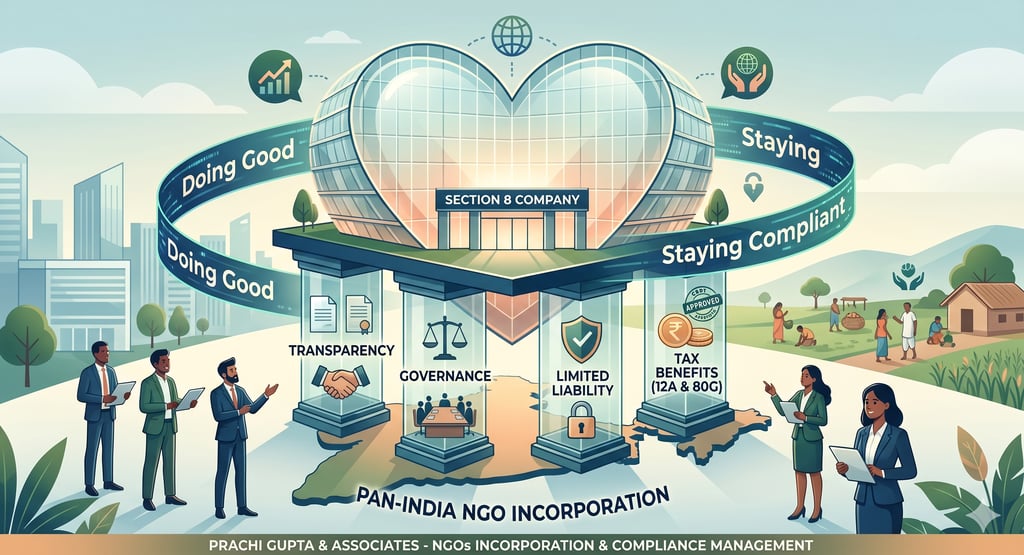
In 2026, social entrepreneurship in India is evolving. While the traditional "Trust" or "Society" remains common, founders seeking long-term credibility, foreign funding (FCRA), and CSR partnerships are increasingly choosing the Section 8 Company. Why? Because it provides a level of institutional trust that a simple registered deed cannot match. At Prachi Gupta & Associates, we specialize in this "Structured Philanthropy."
I. The Credibility Gap: Central vs. State Jurisdiction
Most Trusts and Societies are registered at the district or state level with a local Registrar. A Section 8 Company, however, is licensed by the Central Government via the Ministry of Corporate Affairs (MCA).
The Unique Advantage: This central license serves as an "unspoken endorsement." When applying for government tenders or large-scale CSR grants, the corporate structure of a Section 8 Company signals that you follow rigorous audit and governance standards.
II. The "Shield" of Limited Liability
In a traditional Trust, trustees often carry significant personal risk.
The Unique Insight: A Section 8 Company offers Limited Liability. This means the personal assets of the directors are protected from the liabilities of the NGO. For a social enterprise dealing with large projects or staff, this legal firewall is essential.
III. Dynamic Governance & Exit Strategy
Societies often struggle with internal democratic deadlocks, and Trusts are hard to modify.
The Unique Advantage: Section 8 Companies allow for easier addition or removal of directors and even the transfer of "ownership" (membership). It is a "living" structure that can adapt as your social mission grows.
IV. Compliance: The 12A & 80G Advantage
Registration is only the first step. To make donations tax-deductible for your donors, you need 12A and 80G registrations. * The Proactive Step: Our firm ensures your Memorandum (MoA) is drafted precisely to meet CBDT requirements from Day One, avoiding the common "objective mismatch" that leads to rejection of tax-exempt status.
Conclusion: Don’t let your social mission be limited by an outdated legal structure. Prachi Gupta & Associates provides expert end-to-end incorporation and compliance management for Section 8 companies across India.
#Section8Company #NGOIndia #CSRIndia #CharitableTrust #SocialEntrepreneur #IncomeTaxExempt #12A80G #PrachiGuptaAssociates #FCRA #MinistryOfCorporateAffairs #NonProfitIndia #BusinessForGood
My office
J C HEIGHTS 11, JAGDAMBA NAGAR E, HEERAPURA, AJMER ROAD, JAIPUR, RAJASTHAN
Contacts
prachiguptaassociates@gmail.com
+91 8766383062/ +91 9717591369


Chartered Accountants