
Beyond Bookkeeping: Decoding the 5 Major Tax Audit Triggers to Avoid This Financial Year
Five major, often overlooked, audit triggers to avoid this year.
INCOME TAX
CA Prachi Gupta
4/19/20263 min read
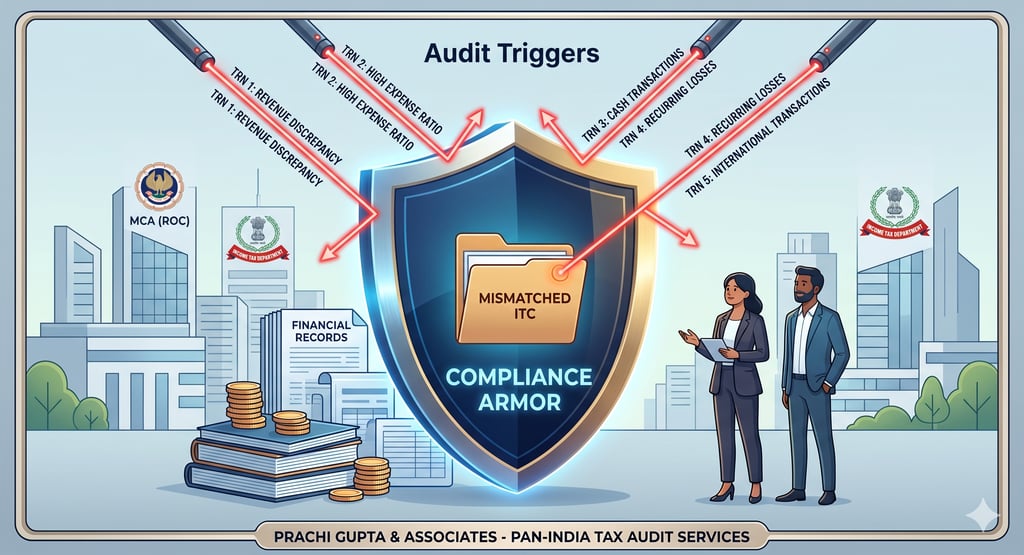
A tax audit is not a statistical lottery; it is almost always a data-driven selection. With the advent of the Computer Assisted Scrutiny System (CASS) and the Centralized Processing Centre (CPC), the Income Tax Department’s ability to identify anomalies has skyrocketed.
For business owners and professionals across India, a tax audit represents more than an administrative hurdle—it is a significant risk to operational focus and financial resources. An audit selection often triggers demands for exhaustive documentation, multiple explanations, and potential penalties.
To navigate this landscape, one must move beyond simple bookkeeping and understand the structured data points that trigger scrutiny. Here are five major, often overlooked, audit triggers to avoid this year.
I. Significant Deviations in the 'Financial Ratios'
CPC’s automated system performs a fundamental ratio analysis on your submitted financial statements. A massive spike in your Gross Profit (GP) or Net Profit (NP), or a massive drop, relative to your previous three years, is an instant flag.
The Unique Scrutiny: The system compares your ratios not just against your history, but also against the industry standard (peer analysis). For example, if you are a pharmaceutical distributor with a GP ratio of 5%, while the industry average (based on PAN-code data) is 15%, your data point is marked. While a business can have varying ratios, a sudden deviation without a documented operational explanation (e.g., launching a low-margin division) is dangerous.
II. High Ratio of Unsecured Loans to Capital
The Income Tax Department views Unsecured Loans with significant skepticism. While it is legitimate to borrow from family and friends, excessive reliance on them, particularly in a high-revenue business, is a major red flag.
The Unique Scrutiny: Under Section 68 (Cash Credits), the onus is on the taxpayer to prove not just the source of the loan, but also the creditworthiness of the lender. If a small proprietor is borrowing crores from an individual with minimal income tax return history, the loan is treated as unexplained income. A very high Unsecured Loan-to-Capital ratio suggests a high risk of capital mismatch.
III. Material Discrepancies in Form 26AS/AIS vs. ITR
Your Annual Information Statement (AIS) is a comprehensive map of your financial interactions. The department knows about every transaction (from high-value cash deposits and mutual fund investments to TDS on professional fees).
The Unique Scrutiny: Many business owners fail to pre-reconcile their AIS with their books. A transaction that is marked 'Reported by Payer' but is not found in your P&L account is a guaranteed automated trigger. A classic mistake is under-reporting 'Revenue from Operations' because you only included 'Taxable Services' and omitted 'Exempt Income' (like some interest income), leading to a 26AS mismatch.
IV. Persistent High Expense Ratio in a Service-Oriented Model
For service providers (consultants, designers, etc.), there is no raw material cost. While operational costs exist, they tend to be lower than in manufacturing or retail. A service business consistently reporting a Net Profit of less than 8-10% is a candidate for scrutiny.
The Unique Scrutiny: High relative expenses for 'Repairs & Maintenance,' 'Traveling & Conveyance,' and 'Miscellaneous Expenses' are frequently scrutinized. The department flags these as categories where personal expenditures are easily masked as business costs.
V. Substantial Year-End Transactions
Sudden, large transactions recorded near the end of the financial year are highly suspicious. A massive purchase of 'Software' on March 29th, or a huge 'Consultancy Fee' paid to a relative on March 31st, suggests that the expense was booked purely to suppress tax.
The Unique Scrutiny: While year-end planning is legitimate, these specific transactions will be selected for intensive verification. You will need a strong 'proof of substance.' A 'Proof of Purchase' (invoice/payment) is not enough; you must provide 'Proof of Utility'—how that specific software or consultancy was used by the business to generate revenue.
Conclusion: Proactive Reconciliation is the Best Defense
A tax audit cannot be absolutely predicted, but it can be prevented. An expert Chartered Accountant firm like Prachi Gupta & Associates doesn’t just perform audit services after the trigger; we provide proactive, digital-first pre-audit reconciliation. We help you identify and rectify these structured triggers before you file your return. Serving clients with pre-compliance expertise across all states and union territories in India.
My office
J C HEIGHTS 11, JAGDAMBA NAGAR E, HEERAPURA, AJMER ROAD, JAIPUR, RAJASTHAN
Contacts
prachiguptaassociates@gmail.com
+91 8766383062/ +91 9717591369


Chartered Accountants